10 Years of Demonetisation in India: Rising Cash Circulation, Digital Payments and Key Challenges
Context: A decade after the November 8, 2016 demonetisation of high-value ₹500 and ₹1,000 notes, Reserve Bank of India (RBI) data shows that currency held by the public has surged to ₹42.55 lakh crore—an increase of nearly 137% over pre-demonetisation levels.

About 10 Years of Demonetisation in India: Rising Cash Circulation, Digital Payments and Key Challenges
What is Demonetisation?
- The sudden invalidation of ₹500 and ₹1,000 currency notes, which constituted roughly 86% of total currency in circulation at the time, aimed at curbing black money, fake currency, and accelerating digitisation.
Currency with the Public: Defined by the RBI as total Currency in Circulation (CIC) minus cash reserves physically held by commercial banks.
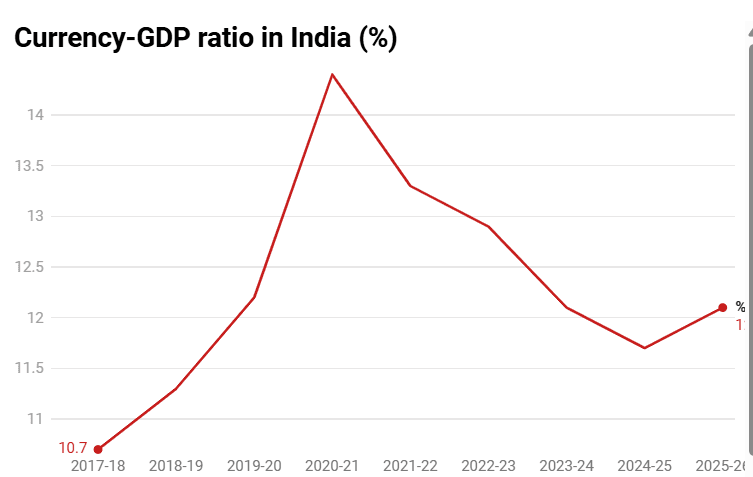
CIC-to-GDP Ratio: An indicator reflecting an economy’s reliance on physical cash relative to its national output. While a lower ratio generally reflects formalisation and smoother monetary policy transmission, a higher ratio indicates enduring transactional or precautionary demand for physical liquidity.
Key Data / Stats: A Decade After Demonetisation
- Surge in Cash with the Public: Rose from ₹17.97 lakh crore on November 4, 2016 (dropping to ₹7.8 lakh crore in January 2017) to ₹42.55 lakh crore as of October 15, 2026—a 136.8% increase.
- Return of CIC-to-GDP Ratio: Stood at 12.1% in March 2016, plummeted to 8.7% in FY 2016–17, spiked to 14.4% during the pandemic year (FY 2020–21), and normalized back to 12.1% in FY 2025–26.
- Global Comparative Standing: India’s 12.1% ratio is higher than the US (7.3%) and China (10.2%), but remains significantly lower than advanced cash-heavy economies like Japan (>16%).
- Scale of Digital Payments: Total digital payments across retail transfers, RTGS, cards, and wallets reached ₹3,251.04 lakh crore in FY 2025–26.
- Card & Wallet Distribution: Credit cards, debit cards, and prepaid wallets accounted for 151,611 lakh transactions worth ₹30.31 lakh crore in FY26, with credit cards driving 78% of value (high-ticket spends) and wallets capturing 51.8% of volume (small-ticket micropayments).
Why Cash Remains King Despite the Digital Boom?
- Expansion of Nominal GDP: As the physical economy expands at 6% to 7% annually, the absolute transactional demand for liquidity naturally expands in tandem without reducing digital adoption.
E.g., Steady expansion of formal GDP to multi-trillion-dollar levels requiring larger absolute working capital floats across commercial supply chains.
- Deep Reliance of the Unorganized & Rural Economy: Over 85% of India’s total workforce remains engaged in the informal sector, where daily wages, agricultural mandi settlements, and village retail rely on instant cash settlement.
E.g., Daily wage disbursements in agricultural harvesting and construction trades where bank/ATM density remains low.
- Precautionary Savings & Crisis Buffers: Households preserve cash reserves as a psychological safety buffer against health, supply-chain, or localized disruptions.
E.g., The sharp liquidity spike in FY 2020–21 when households accumulated physical cash to pay for neighborhood groceries and medical emergencies during lockdown.
- Anonymity, Zero Surcharges & Tax Avoidance: Physical cash incurs zero merchant discount rates (MDR), operates without digital network dependencies, and provides privacy, while avoiding digital audit trails.
E.g., High-value land transactions, informal gold purchases, and unbilled wholesale market trades continuing to utilize cash layers.
Structural Challenges of High Cash Circulation
- Constrained Monetary Policy Transmission: High currency outside the banking system limits commercial bank deposit mobilization, weakening the pass-through of RBI policy rate adjustments to lending rates.
- Persistent Shadow Economy: The availability of high-denomination physical currency continues to facilitate unrecorded commerce and tax evasion.
- High Currency Logistics Overhead: Printing, securing, transporting, and maintaining nationwide ATM networks and currency chests imposes continuous logistical costs on the central bank and commercial banking system.
- Financial Vulnerability for Informal Workers: Workers dependent on cash wages lack formal credit trails, restricting their ability to secure formal institutional credit and social insurance.
Way Ahead:
- Strengthen Rural Financial Inclusion Infrastructure: Expand last-mile Business Correspondent (BC) networks and offline digital payment architectures (such as UPI Lite X) in areas with poor internet connectivity.
- Scale Central Bank Digital Currency (e-Rupee): Accelerate the rollout of the digital rupee (CBDC) with offline and programmability features to combine the convenience of digital payments with the finality and sovereignty of cash.
- Rationalize Merchant Incentive Structures: Keep digital payment acceptance completely friction-free for small merchants by ensuring zero hidden MDR or tax disincentives on entry-level digital transactions.
- Incentivize Digital Wage Payments in Informal Sectors: Link statutory rural works, construction labor payments, and agricultural subsidies exclusively to digital accounts to encourage formal savings habits.
Conclusion:
A decade after demonetisation, India’s monetary landscape presents a duality where a world-leading digital payments ecosystem coexists with an expanding volume of physical cash. The return of the currency-to-GDP ratio to pre-2016 levels demonstrates that cash preference is deeply tied to the informal economy and precautionary savings rather than just a shortage of digital alternatives. Achieving a truly less-cash economy will require addressing the underlying structural drivers of informality, improving digital infrastructure in rural hubs, and fostering formal banking credit trails.
How effective has demonetisation, as a policy, been in achieving its stated goals? How efficiently has it been implemented? Critically examine.