NITI Aayog Launches Report on Impact Assessment of PLI Schemes
Context: NITI Aayog, in collaboration with the Indian Institute of Management Ahmedabad (IIM-A), released a mid-course evaluation report titled “Impact Assessment of PLI Schemes” covering all 14 notified sectors.
About NITI Aayog Launches Report on Impact Assessment of PLI Schemes:
What It Is?
- A comprehensive mid-course evaluation prepared by NITI Aayog and IIM Ahmedabad examining firm-level data across all 14 Production Linked Incentive (PLI) sectors against four core parameters: investment, additional production/sales, employment generation, and export competitiveness.
Evaluation Framework: Measures whether outcomes exceed underlying “natural” industry growth trends, applying a 50% mid-course benchmark (as schemes are 58% through their aggregate tenure) and classifying sectoral outcomes into On-Track, Partial Impact, Insufficient Evidence, and Data Unavailable.
Key Features of PLI Schemes:
- Outcome-Oriented Disbursement: Unlike upfront subsidies, Production Linked Incentive (PLI) schemes release financial incentives only after firms achieve verified incremental production, sales and prescribed investment commitments.
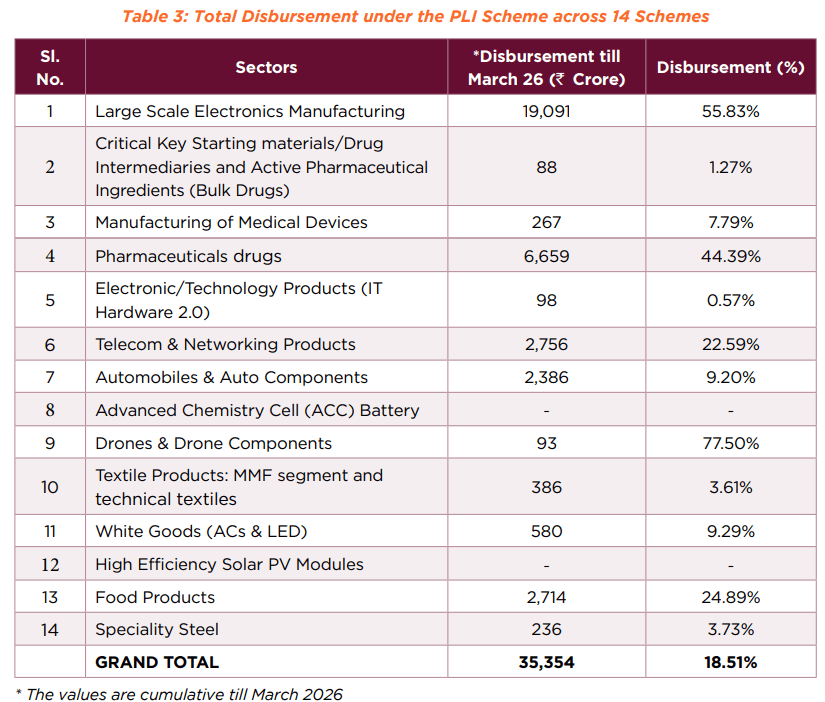
- Targeted 14-Sector Coverage: With a cumulative outlay of ₹1.91 lakh crore, PLI covers 14 strategic sectors, including electronics, pharmaceuticals, textiles, automobiles, solar PV, ACC batteries and drones.
- Time-Bound Sunset Clause: PLI schemes generally operate for 5–6 years, encouraging firms to achieve economies of scale, strengthen global competitiveness and gradually reduce dependence on government incentives.
- Differentiated Sectoral and Firm Tiers: Incentive rates, investment thresholds and Domestic Value Addition (DVA) requirements vary across sectors, accommodating differences in technological maturity, firm size and manufacturing capabilities.
- Ecosystem and Infrastructure Alignment: PLI complements PM GatiShakti, Bulk Drug Parks, PM MITRA Parks and state-level clearances, improving industrial infrastructure, logistics connectivity and manufacturing competitiveness.
Positive Impacts of the PLI Scheme:
- Transformative Growth in Electronics Manufacturing: Mobile production increased 30-fold to ₹5.45 lakh crore, while exports rose nine-fold to nearly ₹2 lakh crore by FY25, strengthening India’s global manufacturing position.
- Reducing Pharmaceutical Import Dependence: PLI enabled domestic production of 191 pharmaceutical products and 55,000 MT capacity across 26 critical APIs, transforming India into a net bulk-drug exporter.
- Deepening Localisation in White Goods: Domestic value addition in air conditioners and LEDs increased from 20% to 55%, supported by localisation of compressors, PCBAs and other essential components.
- Accelerating Clean Technology Manufacturing: PLI supported approximately 24 GW of integrated solar PV capacity, 13.61 lakh electric vehicles and seven-fold growth in drone-sector turnover, strengthening emerging industries.

Challenges Associated with PLI Schemes:
- Shallow Value Addition and Import Dependence: Rapid growth in final assembly has not sufficiently strengthened upstream manufacturing, leaving several industries dependent on imported components and critical raw materials.
E.g., Mobile phones and telecom equipment continue relying on imported display panels, memory modules, battery cells and bare PCBs, limiting domestic value addition despite rising production.
- Gestation Delays and Rigid Localisation Norms: Capital-intensive sunrise sectors face technological gaps, imported machinery dependence and stringent DVA requirements, delaying production, investment realisation and incentive disbursement.
E.g., Under the ₹18,100 crore ACC Battery PLI, only 1.4 GWh capacity was commissioned against 50 GWh targeted, with no commercial production or disbursement reported in the assessment.
- Uneven MSME Participation: High minimum investment requirements, turnover thresholds and compliance burdens have disproportionately favoured large firms, restricting smaller manufacturers’ participation in PLI schemes.
E.g., Stringent eligibility thresholds and HSN code restrictions limited MSME participation in textiles, medical devices and IT Hardware 1.0, necessitating subsequent policy revisions.
- Limited Employment Generation and Data Gaps: PLI generated 8.49 lakh jobs against a 30.18 lakh target, while automation, delayed projects and inconsistent reporting complicated assessment of employment and exports.
E.g., Inconsistent export reporting across automobiles, white goods and medical devices, alongside possible production reclassification, complicates verification of genuinely additional manufacturing output.
Recommendations of NITI Aayog:
- Combine Demand-Pull with Supply-Push Incentives: Complement production subsidies with government procurement, downstream demand incentives and export promotion to ensure sustained market demand and long-term commercial viability.
- Standardise Cross-Ministerial Reporting: Establish uniform reporting standards for production value, physical output, net exports, domestic value addition and employment, supported by automated verification and regular monitoring.
- Adopt Sector-Specific and Consultative Targets: Design investment thresholds, gestation periods and localisation requirements through industry consultations, accounting for technological complexity and sector-specific manufacturing challenges.
- Strengthen Upstream Ecosystems and MSME Integration: Support component manufacturing, domestic R&D and MSME supplier networks through complementary initiatives, reducing import dependence and increasing indigenous value addition.
- Improve Centre–State Coordination and Evaluation: Establish institutional mechanisms to resolve land, labour and regulatory bottlenecks, while assessing capital-intensive sectors over realistic implementation timelines.
Conclusion:
NITI Aayog’s assessment highlights PLI’s contribution to manufacturing expansion, exports and investment, particularly in electronics and pharmaceuticals. However, achieving Viksit Bharat @2047 requires deeper domestic value addition, MSME integration, flexible sectoral targets and stronger demand-side support, alongside transparent monitoring and coordinated implementation.
“India’s electronics manufacturing success must increasingly be measured by domestic value creation rather than the volume of finished products assembled.” Discuss.