Mapping
Bhadra Wildlife Sanctuary
Context: Amid protests over rising human-elephant conflict in Hassan, Karnataka announced plans to relocate 56 wild elephants from Belur taluk to Bhadra Wildlife Sanctuary within a month.

About Bhadra Wildlife Sanctuary:
What it is?
- A premier protected area, wildlife sanctuary, and designated Project Tiger Reserve nestled in the Western Ghats of Karnataka, renowned for its dense bamboo-rich forests and successful big-cat conservation.
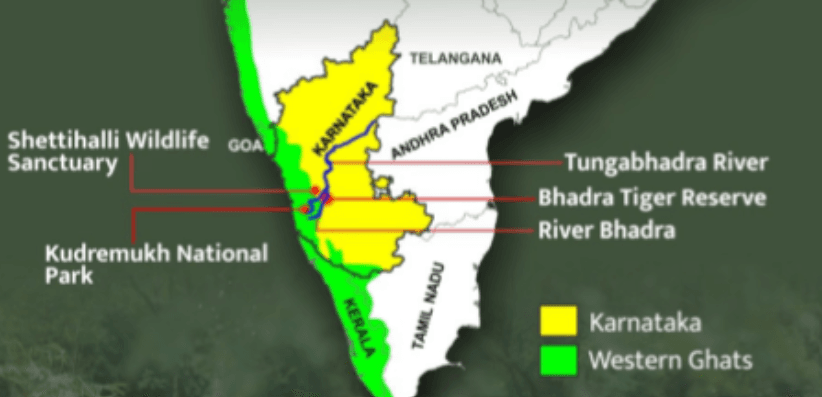
Located in: Spread across the Malnad districts of Chikkamagaluru and Shivamogga in Karnataka, covering a total Tiger Reserve area of approximately 1,072 sq. km.
History:
- Originally notified in 1951 by the erstwhile State of Mysore as the Jagara Valley Game Sanctuary (covering 77.45 sq. miles).
- Expanded and declared as the Bhadra Wildlife Sanctuary in 1974 (492.46 sq. km), and formally brought under Project Tiger in 1998 (notified as Karnataka’s fourth Tiger Reserve in 2007).
- Became India’s first tiger reserve to successfully complete voluntary village relocation (2002–2004), resettling over 400 families at M.C. Halli outside the forest.
Key Characteristics of Bhadra Wildlife Sanctuary:
- Saucer-Shaped Topography: Surrounded by Mullayanagiri, Hebbegiri, Gangegiri and Baba Budan Giri hills, forming a distinctive basin-shaped landscape within the Western Ghats.
- Bhadra River & Reservoir: Traversed by the Bhadra River, a tributary of the Tungabhadra, with its western boundary adjoining the Bhadra Reservoir backwaters.
- Diverse Forest Ecosystems: Supports moist and dry deciduous forests, shola grasslands, teak, rosewood and bamboo, including the approximately 400-year-old Jagara Giant teak tree.
- Rich Biodiversity: Shelters tigers, elephants, leopards, gaur, dholes and sloth bears, alongside over 250 bird species, including Malabar trogons and hornbills.
- Ecological Connectivity: Forms part of the Kudremukh–Bhadra–Shettihalli landscape, supporting wildlife movement, habitat connectivity and conservation of tiger and elephant populations.
Significance:
- Demonstrates how voluntary rehabilitation of forest communities can restore wildlife habitats, reduce human disturbance and support tiger and prey population recovery.
- Provides critical habitat for tigers and elephants, while highlighting the challenge of mitigating human-elephant conflict without disturbing protected ecosystems.