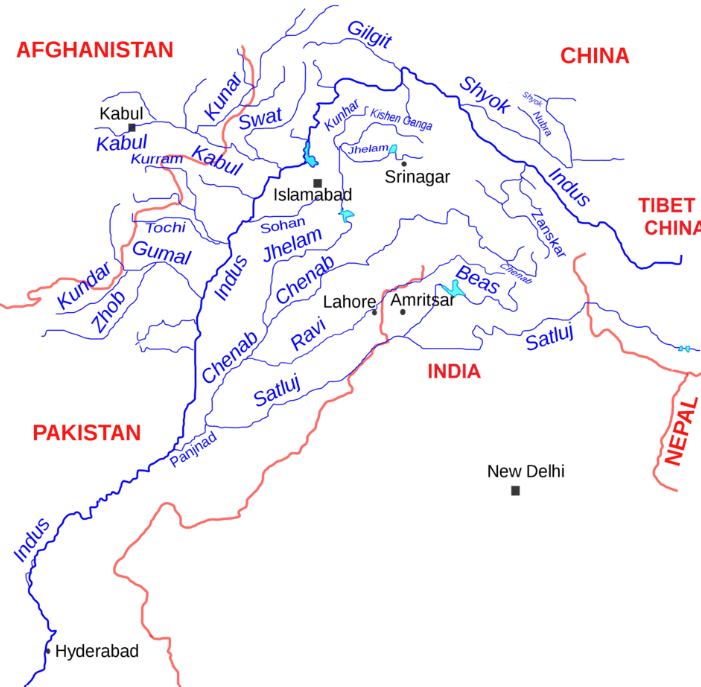
The Indus River
Context: At COP31 in Türkiye, Environment Minister stated that transboundary water-sharing must reflect broader bilateral relations, defending India’s decision to hold the Indus Waters Treaty (1960) in abeyance amid tensions with Pakistan.

About The Indus River:
What it is?
- One of the longest and most historically significant transboundary rivers in Asia (stretching approximately 3,180 km in total length, with roughly 1,114 km flowing through India), forming the backbone of the Indus River Basin across South Asia.
Origin: Originates in the Tibetan Plateau (China) from a glacier near Bokhar Chu at an altitude of about 5,182 metres in the Kailash Mountain range, close to Lake Mansarovar, where it is locally known as Singi Khamban (Lion’s Mouth).
Tributaries of the Indus:
- Left-Bank Tributaries (Panjnad / Himalayan Rivers): Jhelum, Chenab, Ravi, Beas, and Sutlej, along with the Zanskar and Suru rivers in Ladakh.
- Right-Bank Tributaries: Shyok, Gilgit, Hunza, Nubra, Kabul, Swat, Kurram, Tochi, and Gomal rivers.
Nations Flows Through: China (Tibet Autonomous Region), India, and Pakistan (with a small portion of its upper catchment basin extending into Afghanistan via the Kabul River).
Key Features of the Indus River:
- Antecedent Trans-Himalayan River: The Indus flows through deep Himalayan gorges near Nanga Parbat, indicating that its course existed before the major uplift of the Himalayas.
- Snow & Glacier-Fed River: Receives significant water from melting glaciers and snow in the Karakoram, Hindu Kush and Himalayas, making its flow sensitive to climate change.
- Fertile Alluvial Plains: Forms wide floodplains and braided channels across Punjab and Sindh, depositing fertile sediments that support agriculture and human settlements.
- Indus River Delta: Forms a vast delta southeast of Karachi in Pakistan, covering approximately 41,440 sq. km before draining into the Arabian Sea.
- Indus Waters Treaty (1960): Allocated Ravi, Beas and Sutlej to India, while Indus, Jhelum and Chenab were primarily allocated to Pakistan; India placed the treaty in abeyance in 2025.
Significance:
- Supported the Indus Valley (Harappan) Civilisation (3300–1300 BCE), one of the earliest urban civilisations, and influenced India’s historical name.
- Supports Pakistan’s extensive irrigation network and offers hydropower potential, making it crucial for agriculture, water security and India–Pakistan relations.