
India’s Export Performance 2026–27: Key Trends
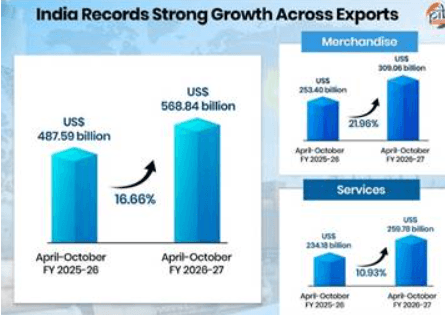
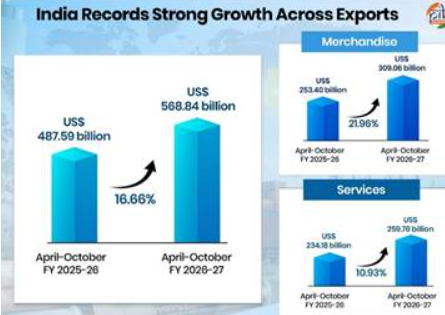
Context: India’s total exports rose 16.66% year-on-year to US$ 568.84 billion during April–October FY 2026–27, recording seven consecutive months of positive growth across both merchandise and services.
About India’s Export Performance 2026–27: Key Trends
What It Is?
- A comprehensive performance milestone tracking the outbound trade of Indian goods (merchandise) and services during the first seven months (April–October) of FY 2026–27, underpinned by export promotion policies, logistics digitization, and expanding bilateral and regional trade agreements.
Key Statistics on India’s Exports (April–October FY 2026–27)
Overall Export Performance:
- Total Exports: US$ 568.84 billion, registering 16.66% growth over the previous year.
- Merchandise Exports: Increased by 21.96%, while services exports grew by 10.93%.
- October 2026: Exports reached US$ 89.99 billion, up 29.90% year-on-year.
Top 5 Fastest-Growing Export Destinations:
| Country | Export Growth |
| Singapore | 107.50% |
| Malaysia | 106.87% |
| Spain | 88.38% |
| South Africa | 62.20% |
| Sri Lanka | 60.42% |
Top 5 Fastest-Growing Export Categories
| Export Category | Growth |
| Other Cereals | 109.74% |
| Petroleum Products | 47.71% |
| Electronic Goods | 46.92% |
| Meat, Dairy & Poultry | 40.81% |
| Handicrafts | 36.05% |
Other Important Highlights
- Non-Petroleum Exports: Grew 18.01% to US$ 259.22 billion, showing strength beyond petroleum products.
- Services Sector: Contributed nearly 45.7% of total exports, strengthening India’s global trade position.
- Export Diversification: India earned US$ 622.1 million from 1,985 new product-market combinations during April–September 2026.
- Foreign Investment: Net FDI inflows reached US$ 8.8 billion during April–September 2026.
- Forex Reserves: Stood at US$ 719.55 billion as of November 6, 2026.
Policy Initiatives Driving Export Growth:
- Export Promotion Mission (EPM) & RELIEF: The ₹25,060 crore EPM supports MSMEs and new exporters through finance and compliance assistance, while ₹497 crore RELIEF addresses rising freight and insurance costs.
- Duty Remission & Input Schemes: RoDTEP and RoSCTL provide export duty relief until December 2026, while Advance Authorisation, DFIA and EPCG enable duty-free access to inputs and capital goods.
- Grassroots & Digital Export Infrastructure: Districts as Export Hubs (249 districts), 1,013 Dak Ghar Niryat Kendras, e-commerce export hubs and 8 new SEZs strengthen export infrastructure.
- Logistics & Customs Digitization: ULIP integrates 46 government systems, while LDB, ICEGATE and Trade Connect improve shipment tracking, customs clearance and exporter access to information.
Structural Challenges & Risks Ahead:
- Global Geopolitical & Maritime Supply-Chain Shocks: Ongoing conflicts in West Asia and Eastern Europe elevate maritime freight rates, war-risk insurance premiums, and shipping transit times for Indian exporters.
E.g., Exporters relying on Red Sea and Persian Gulf shipping lanes requiring emergency fiscal relief under the RELIEF component to absorb freight spikes.
- Non-Tariff Barriers & Carbon Border Taxes: Rising protectionism, stringent sanitary/phytosanitary standards, and environmental compliance mandates in advanced markets threaten traditional exports.
E.g., Engineering goods, steel, and agricultural shipments facing compliance hurdles under the EU’s Carbon Border Adjustment Mechanism and strict residue norms.
- Import Intensity in High-Growth Manufacturing: Rapid export expansion in electronics and engineering goods still relies heavily on imported intermediate components, limiting net domestic value addition.
E.g., High-value semiconductor wafers, display assemblies, and specialized precision machinery remaining import-dependent despite rising final assembly exports.
- MSME Scale & Trade Finance Bottlenecks: Small exporters in interior districts continue to face high working capital costs, complex international certification expenses, and limited global branding reach.
Way Ahead:
- Expedite Pending FTA Negotiations & Implementation: Conclude ongoing trade talks with the US, Canada, and GCC while ensuring smooth operationalization of the upcoming India–EU FTA to secure tariff advantages for labour-intensive sectors.
- Deepen Backward Linkages & Component Localization: Align Foreign Trade Policy incentives with PLI and semiconductor missions to indigenize upstream supply chains in electronics, chemicals, and engineering goods.
- Scale Affordable Trade Finance & Credit Guarantees: Expand low-cost export credit, factoring services, and digital collateral-free lending for MSMEs under the Export Promotion Mission.
- Strengthen Green Compliance & Quality Testing Infrastructure: Establish accredited testing and carbon-accounting hubs at district clusters to help MSMEs meet international sustainability and phytosanitary standards.
Conclusion:
India’s strong export performance in the first seven months of FY 2026–27 highlights the resilience of its external sector, driven by high-value electronics, diversified agricultural shipments, and steady services growth. Backed by targeted trade agreements, digital logistics platforms, and MSME-focused interventions like the Export Promotion Mission, India is steadily expanding its footprint in global value chains. Sustaining this trajectory amid global trade headwinds will require deepening domestic value addition, lowering logistics costs, and equipping smaller exporters to navigate emerging regulatory standards.
Examine the significance of services exports in India’s external sector. Assess the limitations of relying on the services surplus to offset the merchandise trade deficit. Suggest measures to achieve a more balanced export structure.
Recent & Most Viewed

Download Our App
Use the Teaching Pariksha app for personalised quizzes, smart revision nudges and doubt solving.

