Prelims
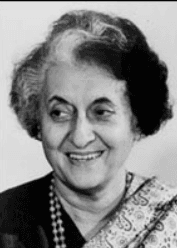
Indira Gandhi
Context: Prime Minister of India paid floral and social media tributes to former Prime Minister Indira Gandhi on her 109th birth anniversary, honouring India’s first and only woman Prime Minister.

About Indira Gandhi:
Who she was?
- India’s first and only female Prime Minister, serving as the third Prime Minister of India across two tenures (January 1966 – March 1977 and January 1980 – October 1984), and widely regarded as one of the most consequential and decisive leaders in modern Indian history.
Early Days & Education:
- Born on November 19, 1917, in Allahabad (now Prayagraj) into the illustrious Nehru family to Pandit Jawaharlal Nehru and Kamala Nehru.
- Received a cosmopolitan education across premier institutions including Visva-Bharati (Santiniketan), Ecole Nouvelle (Switzerland), Badminton School (Bristol), and Somerville College, Oxford.
- Actively participated in the Indian freedom struggle from childhood—organizing the Bal Charkha Sangh and the Vanar Sena (Monkey Brigade) of children in 1930 to assist the Congress during the Civil Disobedience Movement.
- Married Feroze Gandhi on March 26, 1942, with whom she had two sons, Rajiv and Sanjay.
Parties Associated With:
- Indian National Congress (INC): Joined the Congress Working Committee in 1955, served as President of the Indian National Congress (1959–60), and entered Parliament via the Rajya Sabha in 1964 as Minister for Information and Broadcasting.
- Congress (R) / Indian National Congress (Indira) [INC(I)]: Following the historic 1969 party split against the Syndicate, she led Congress (Requisitionists), and after a second split in January 1978, founded and presided over the Indian National Congress (Indira)—which became the mainstream Congress party.
Her Contributions to India:
- 1971 Bangladesh Liberation: Led India’s decisive victory in the 1971 India–Pakistan War, facilitating Bangladesh’s creation and strengthening strategic autonomy through the Indo-Soviet Treaty (1971).
- Green Revolution & Food Security: Promoted high-yielding seeds, irrigation and rural credit, accelerating agricultural productivity and reducing India’s dependence on imported food grains.
- Economic & Socialist Reforms: Nationalised 14 banks (1969) and six (1980), abolished Privy Purses (1971) and promoted poverty alleviation through the Garibi Hatao campaign.
- Scientific & Technological Advancement: Oversaw Pokhran-I (1974), established the Department of Space (1972), launched Aryabhata (1975) and initiated Antarctic research (1981).
- Environment & Constitutional Developments: Introduced the Wildlife Protection Act (1972) and Project Tiger (1973), integrated Sikkim (1975), but faced criticism over the Emergency and 42nd Amendment.
Last Days:
- Operation Blue Star (1984): Authorised military action against armed militants inside the Golden Temple complex, resulting in casualties, damage to the Akal Takht and widespread Sikh resentment.
- Assassination (October 31, 1984): Assassinated by bodyguards Beant Singh and Satwant Singh at her Safdarjung Road residence, New Delhi, while heading to an interview; cremated at Shakti Sthal.