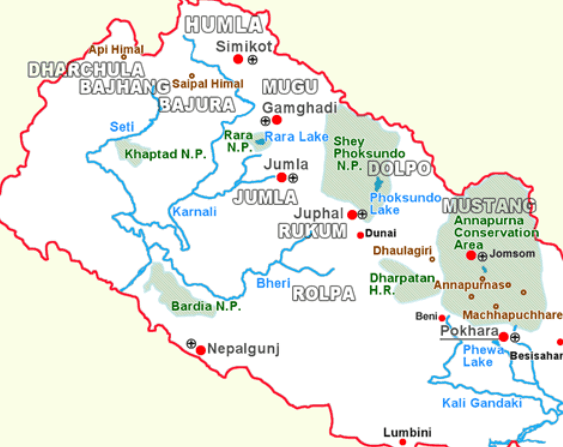
Mapping
Shey-Phoksundo National Park
Context: Six Indian tourists stranded in heavy snowfall at high-altitude mountain passes (Numla and Wagla) near Shey Phoksundo Lake were successfully rescued by a private helicopter after being out of contact for two days.
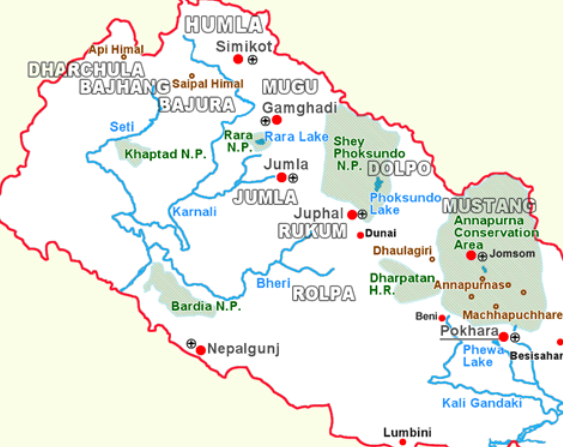
About Shey-Phoksundo National Park:
What it is?
- The largest national park in Nepal and the country’s only protected area situated within the trans-Himalayan ecological zone. Managed by the Department of National Parks and Wildlife Conservation (DNPWC), it covers an expansive area of 3,555 square kilometres.
Located in: Spans the Dolpa and Mugu districts of Karnali Province in northwestern Nepal, approximately 300 km northwest of Kathmandu, with park administrative headquarters based at Palam in Dolpa.
Background:
- Established in 1984 to conserve the fragile trans-Himalayan ecosystem, unique cold-desert landscapes, and endangered high-altitude wildlife.
- A dedicated buffer zone of 216 square kilometres was declared in 2006 to support local community co-management and sustainable forest use.
- Its centerpiece, the oligotrophic Phoksundo Lake, was designated as a Ramsar Site (Wetland of International Importance) in September 2007.
Key Characteristics:
- Extreme Altitudinal & Topographical Gradient: Extends from 2,130 metres near Ankhe to 6,883 metres at Kanjiroba Himal, encompassing diverse Himalayan landscapes and high-altitude ecosystems.
- Alpine Waterbodies & Drainage: Features Phoksundo Lake (3,612 m), renowned for its turquoise waters and 167-metre waterfall, alongside the Langu, Suligad and Jugdual river systems.
- Snow Leopard Habitat: Supports a significant population of snow leopards (Panthera uncia), sustained by prey species such as blue sheep, Himalayan musk deer and argali.
- Trans-Himalayan Rain-Shadow Flora: Dominated by arid shrubs, juniper and Tibetan plateau vegetation, while moist southern valleys support birch (Bhojpatra) and silver fir forests.
- Bon & Buddhist Cultural Heritage: Preserves Shey Gompa monastery and Ringmo village, safeguarding ancient Tibetan Buddhist traditions and the indigenous pre-Buddhist Bon-po religion.
Significance:
- Serves as a vital Trans-Himalayan wildlife corridor, supporting snow leopard conservation, high-altitude biodiversity research and cross-border ecological connectivity.
- Preserves traditional agro-pastoral livelihoods, ancient monasteries and Himalayan pilgrimage routes, promoting sustainable tourism alongside cultural and ecological