Tackling India's Air Pollution Crisis: Need for a Citizen-Led Clean Air Movement
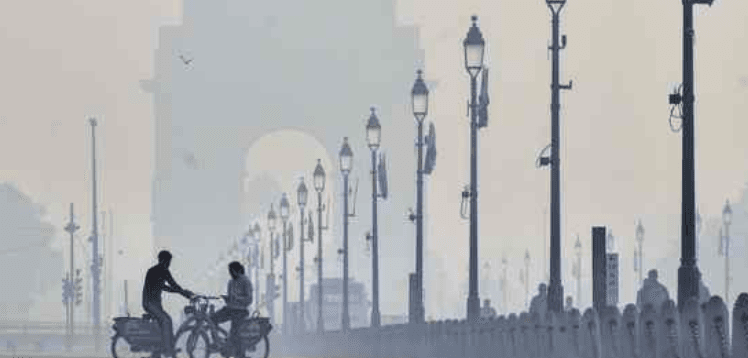
Context: Following post-Deepavali AQI spikes to 400 in Delhi-NCR and GRAP Stage III restrictions, experts urged a year-round citizen-led anti-pollution movement modelled on the Swachh Bharat Mission.

About Tackling India’s Air Pollution Crisis: Need for a Citizen-Led Clean Air Movement
What It Is?
- A recurring, multi-sectoral public health emergency driven by vehicular emissions, construction dust, industrial effluents, agricultural stubble burning, and open waste burning, compounded by winter meteorology across the Indo-Gangetic plain.
Key Data & Health Impact:
- Hazardous Pollution Levels: Air in most Indian cities contains particulate matter and pollutants roughly 8 times higher than World Health Organization (WHO) safety thresholds, with NCR AQI levels reaching 400 (affecting ~80 million residents).
- Life Expectancy Loss: According to the Energy Policy Institute at the University of Chicago (EPIC) 2025 report, air pollution reduces average life expectancy in India by 5 years, ranking India as the world’s second most polluted country.
Recent Regulatory Interventions:
- CAQM & GRAP Escalation: The statutory Commission for Air Quality Management (CAQM) escalated GRAP from Stage I to Stage III within 15 days, halting Construction and Demolition (C&D) activities, intensifying Pollution Under Control Certificate (PUCC) checks, and inspecting stubble-burning sites in Punjab.
- PAVAN-I3C & Emission Reduction Targets: Deployed PAVAN-I3C (Integrated Command and Control Centre) for real-time industrial and traffic monitoring, while directing Delhi and NCR states to reduce annual pollution levels by 15–20%.
Need for a Citizen-Led Movement:
- Limitations of Top-Down Enforcement: Emergency fines, construction bans, and border vehicle restrictions offer only partial, seasonal deterrence and often trigger road congestion without permanent behavioral change.
- Proven Behavioral Template from SBM: The Swachh Bharat Mission transformed sanitation habits among 600 million open defecators by saturating rural India with 2,500–3,300 targeted communication messages per person (2015–19) and mobilizing top political leadership and local influencers.
- Community Ownership Model (Indore): Indore’s sustained status as India’s cleanest city—engaging over 35 lakh citizens in zero-waste initiatives—demonstrates that lasting change occurs when authorities pair enabling waste infrastructure with civic pride and ownership.
- Alignment with Mission LiFE & Ek Ped Maa Ke Naam: Global adoption of India’s Lifestyle for the Environment (LiFE) behavioral framework could cut annual emissions by 2 billion tonnes by 2030, complementing mass afforestation drives like Ek Ped Maa Ke Naam (which planted over 260 crore trees in two years).
Challenges in Tackling Air Pollution:
- Reluctance to Alter Personal Lifestyle Habits: Despite metro expansions and cleaner public transit options, private vehicle owners remain hesitant to give up personal cars or follow voluntary work-from-home and waste-segregation practices.
E.g., Citizens demanding the health benefits of clean air under GRAP while continuing open biomass burning and ignoring firecracker restrictions during Deepavali.
- Reactive, Seasonal Communication & Border Chaos: Environmental agencies rely on last-minute punitive notifications rather than continuous public awareness, causing confusion and non-compliance.
E.g., Traffic chaos and bottlenecks at Delhi’s borders due to inadequate advance communication regarding entry restrictions on higher-emission out-of-state vehicles.
- Over-Reliance on Band-Aid Technological Fixes: Municipal authorities frequently divert scarce funds toward temporary, cosmetic measures rather than structural behavioral and regulatory solutions.
E.g., Spending heavily on anti-smog guns, water sprinkling, and artificial rain pilots instead of sustained public communication and EV adoption campaigns.
- Disconnect Between Civic Conscience and Personal Incentives: General appeals to environmental duty fail to motivate action unless citizens clearly understand the direct health and financial benefits of cleaner choices.
Way Ahead:
- Launch Year-Round Behavioral Communication Campaigns: Reallocate funds from temporary anti-smog gimmicks toward continuous, high-frequency multimedia campaigns explaining vehicle rules, health costs, and financial savings from switching to Electric Vehicles (EVs) and CNG.
- Conduct Grassroots Workshops & Training: Institutionalize regular orientation camps through State Pollution Control Boards across Resident Welfare Associations (RWAs), schools, colleges, farmer cooperatives, transport unions, and factory floors.
- Pair Enabling Systems with Citizen Duties: Strengthen last-mile public transport, segregated municipal waste collection, and crop-residue management infrastructure so citizens can easily adopt Reduce, Reuse, Recycle (RRR) habits without open burning.
- Mobilize Political Leadership & Local Champions: Rally national leaders, local influencers, and community bodies to turn clean air into a year-round mass jan andolan (people’s movement) rather than a seasonal winter emergency.
Conclusion:
India’s recurring winter smog proves that statutory crackdowns and emergency GRAP restrictions alone cannot secure breathable air across cities. Drawing on the behavioral mobilization lessons of the Swachh Bharat Mission and Mission LiFE, authorities must pair strict institutional monitoring with sustained, year-round citizen engagement. Transforming clean air from a seasonal regulatory battle into a collective civic duty is essential to protecting public health and realizing a truly developed India.
What is source apportionment in air-pollution management? How can it improve the effectiveness of urban clean-air strategies in India?